


In 2016, Beyoncé’s Lemonade visual album took everyone by surprise, featuring record-breaking tracks like “Sorry,” “Formation,” and “Hold Up.” The album became a controversial topic immediately upon its release, as it came barely two years after her sister Solange’s elevator altercation with Jay-Z, an incident that shook social media. Many people suggested that the “Becky with the good hair” Beyoncé referenced in the video was the reason for Solange’s attack on Jay-Z.
While Hollywood speculated on whether Lemonade was about Jay-Z’s infidelity, Nigerians had their eyes fixed on something else—the artwork on the bodies of the women in the visual album.
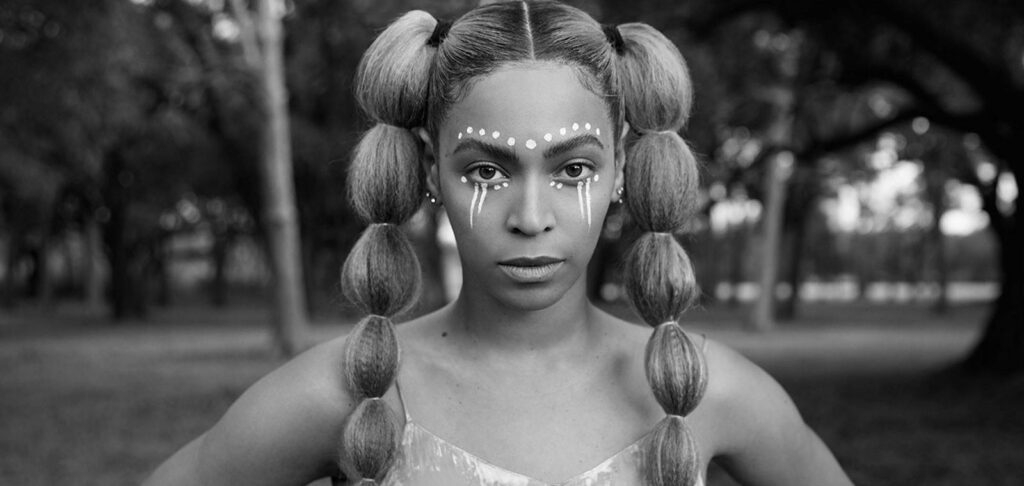
These intricate white markings resonated deeply. They were like familiar whispers. Like kindred spirits, they spoke to us, called our names, and told our stories – a true reflection of Nigerian heritage. Witnessing this art on such a global stage felt like a homecoming. For the first time in a long time, we felt seen, heard, acknowledged, and celebrated. We felt like a part of something way bigger, like Beyonce’s lyrics go.
And the reason for that? The man, the legend—Laolu Senbanjo.
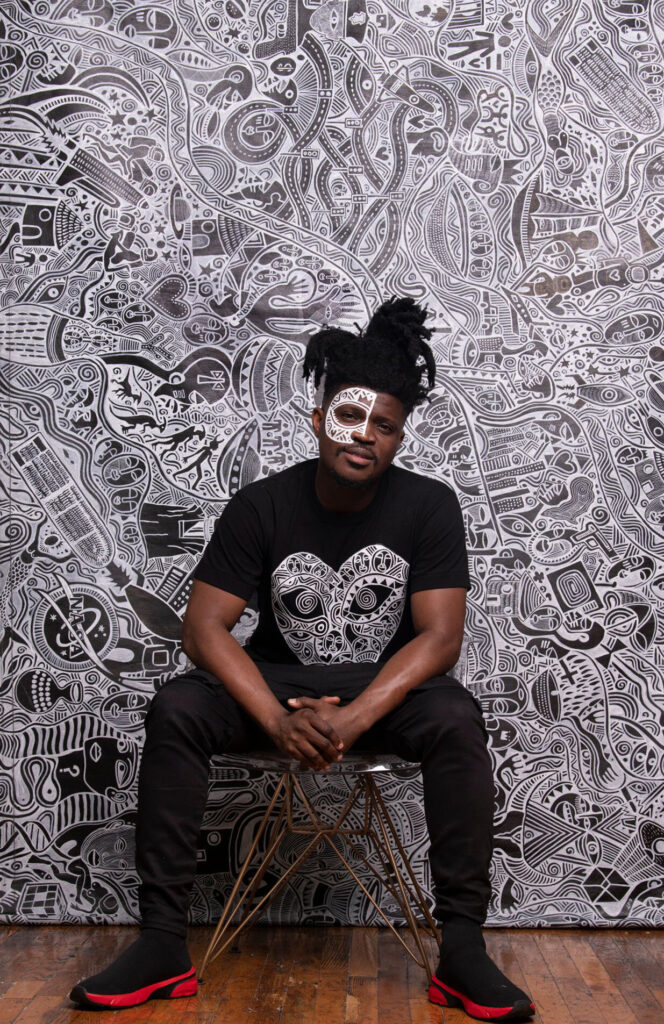
YORUBA ART IS TAKING FLIGHT, THANKS TO LAOLU NYC
Olaoluwa Sebanjo, popularly known as Laolu NYC is a Nigerian visual artist, musician, human rights attorney, and activist. The Illorin-bred artist has lived many lives and conquered many territories. Laolu to me, is a culture custodian, and one whom I reckon could lead Nigeria to a revolution using the arts.
I say this because Laolu is in no way a minimalist. He loves his art to be bold, loud, noticed, and seen in all its glory. And that’s what Nigerian art needs on every front – From Nollywood to music, to fashion. Laolu believes that art should not be limited to surfaces considered art-worthy, like canvases or the walls of museums. Everything around us could feel the art, just as everything around us could become art – Your shoes, cars, laptops, notebooks, the human body and his most recent project, spaceships!
Yoruba art is taking flight and touring the universe, thanks to Laolu’s relentless and dogged attitude. Laolu’s goal is to ensure that art that looks like ours, indigenous art, goes to the highest possible platforms, where art is not exactly expected. And who knows? Through Yoruba art, we may just be able to communicate with aliens.
But before our latest attempts at communicating with the aliens through the ancient Yoruba artworks Laolu has made mainstream, let’s go back to where this all began.
Laolu grew up in Illorin in a middle-class family with a lawyer for a father and a nurse for a mother – talk about getting the best of both worlds. Growing up in such a family, it was almost seen as taboo to consider the arts as a career path and so, Laolu, like many of us in the same position, did the respectable thing by earning a degree.
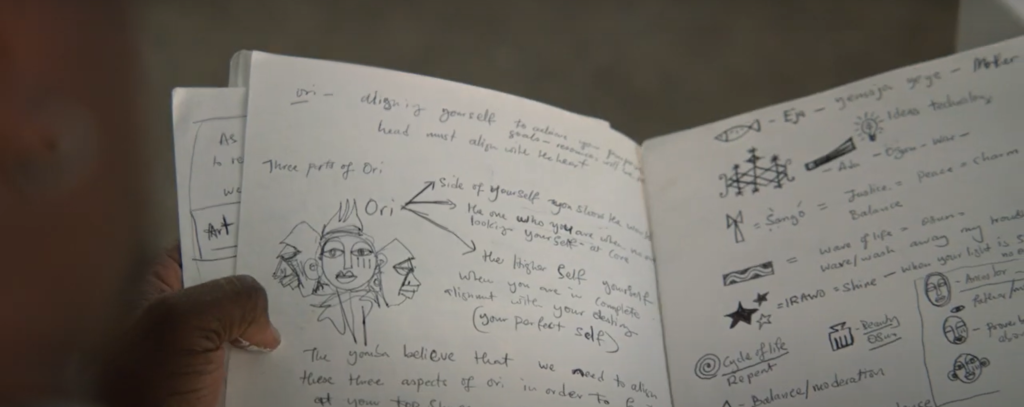
He became a human rights lawyer. However, the idea that everything is his canvas was borne out of sheer need to express himself. He started drawing on everything and anything from his university days, even up until law school, and even after law school.
This is what Laolu had to say about this: “As a way to sort of rebel, there was just that inclination to always draw on surfaces that were not considered art surfaces.”
For Laolu, these drawings on his notebooks became a way of understanding both law school materials and otherwise, and ultimately, it became a way by which he understood himself.
LAOLU IN NYC
Like his favorite Yoruba proverb, ‘Ori ni a ba bo, ka fi Orisha si’le,’ which means that while we have destinies assigned to us by the gods, we also have a hand in our fate, Laolu took control of his destiny by taking a giant leap of faith and changing his location.
He worked as a human rights activist and lawyer in Nigeria for a few years, and while witnessing all the injustices the young kids in the North faced, painting became his outlet. Soon after, he decided it was time to relocate and pitched his tent in Brooklyn, New York. He chose New York, which he deems the centre of the world because he experienced the art scene and saw New York as a place where artists thrive. And for the first time, he could truly be the artist he wanted to be. Laolu tells us that New York is the only place he never had to introduce himself as a lawyer. And he was fully accepted for who he was.

However, adjusting to a new society with different rules, cultures, and orientations wasn’t easy for him. Living as a black person in America brought daily anger and challenges that were unfamiliar in Nigeria. As a black artist and activist, he felt compelled to depict these experiences and use art to speak out against injustices.
Moving to the US also opened his eyes to a lot of ignorance about what people think art is and what art should look like.
“African art has been discounted for too long and written out of history books. We have also written ourselves out of history, especially on the global stage.” He starts. He goes on to wonder why we usually don’t talk about the genius of Yoruba art and all the people who have come before us.
LAOLU ON AFROMYSTERICS
Laolu describes his art form as “the sacred art of the Ori.”
In Yoruba mythology, “ori” means your essence, soul, and instincts, and it also literally means head or leader. The word “ori” in Yoruba culture goes beyond its English meaning of “head” as the seat of sensory organs; it represents the total nature of its bearer. The physical “ori” symbolizes the “inner head” or “inner person” (ori-inu) and occupies a central place of sacredness.
For the Yoruba people, “Ori” is an object of worship. The physical head is a mere symbol, housing the “real” head (ori-inu), the spiritual counterpart. To the Yoruba, Ori is the most important part of a person.
Laolu’s art is a form of worship. It is an awakening for all who encounter it. It is a sacred and religious insight into the myths, legends, and stories of the Yoruba people. It is no wonder he often refers to it as AFROMYSTERICS.
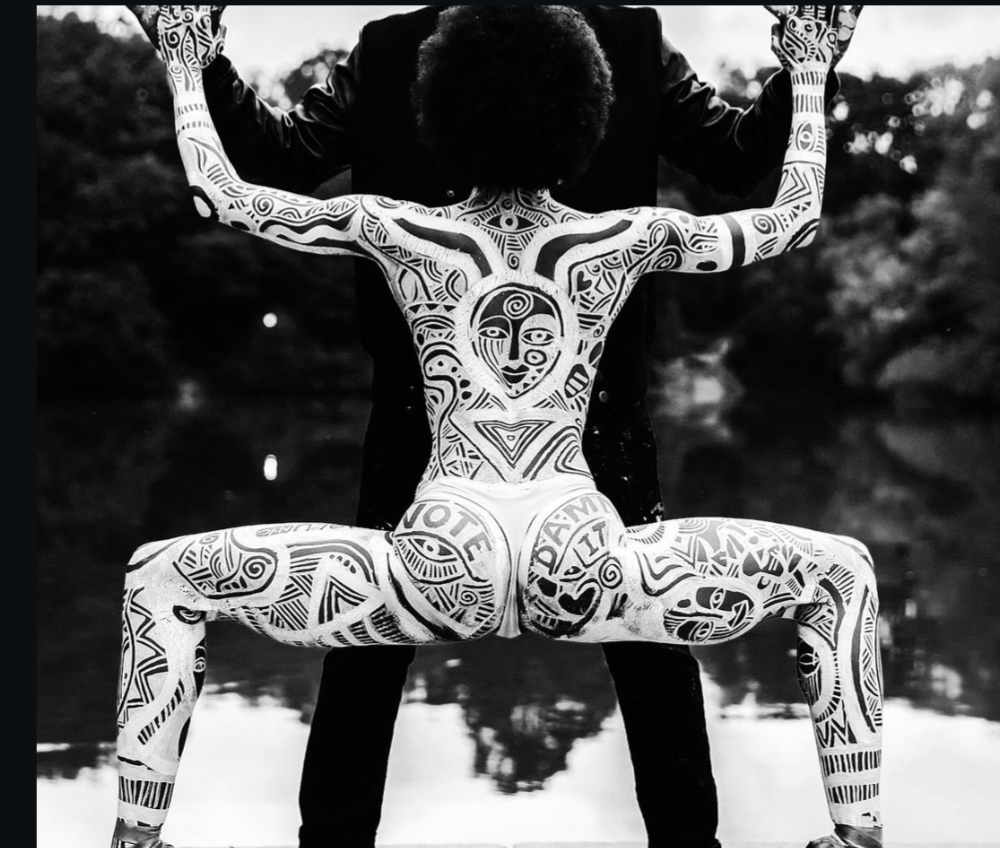
Laolu describes Afromysterics, which was born in 2016, as the mysteries of African thought patterns. “The thought is the wisdom, and the patterns are the mysteries of Yoruba symbols.” He added. Laolu believes that a lot of the mysteries of Yoruba myths and traditions are embedded in patterns in his art.
He tells us that a lot of the content of the art is messaging. “When you consume art, the art is always trying to say something. There is always a story behind it – And that’s what Afromysterics is. It’s telling a story through arts and patterns and locking it into proverbs and sayings. It’s a form of communication.”
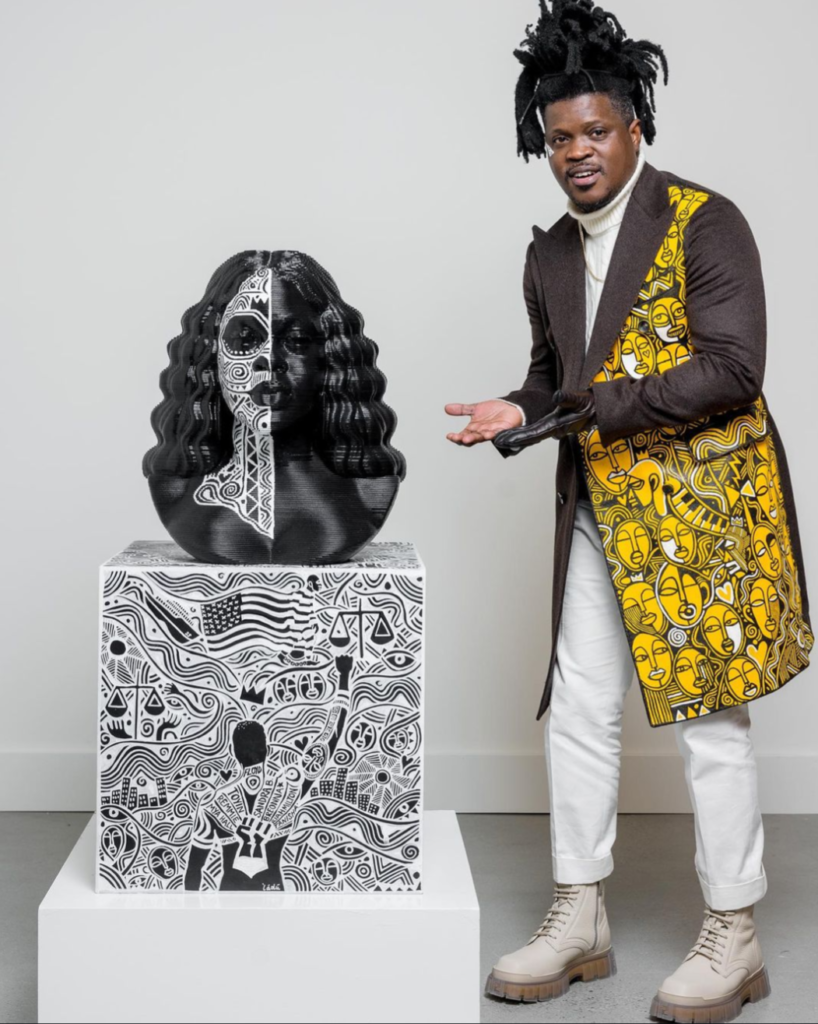
Laolu likens his art to Egyptian hieroglyphs, and the parallels are compelling. Both are sacred, ancient art forms that use dots, lines, and patterns to convey profound spiritual meanings. Egyptian hieroglyphs and Yoruba Ori artworks alike tell stories of gods, the afterlife, and the essence of the soul. Each serves as a powerful spiritual symbol, deeply connected to the divine and preserving the cultural and ancestral wisdom of its people.
“When you look deeply into the Osogbo style art, adire, and other ancient art forms, which many people often take for granted, you see that there are patterns and symbols that all mean something.” He added.
He also paid homage to Nike Okundaye, Tola Wewe, and Bruce Onobrakpeya, a few of the artists who he says stand for the idea of afromysterics. “Unfortunately, this has been lost to a whole generation because we do not know how to read it. Just because we cannot understand it, doesn’t mean it is not saying something” Laolu chimed.
And his comment got me thinking. How many times have I seen artworks and not been able to understand them? I never imagined that these strokes, dots and beautiful lines had stories, proverbs, songs, and myths locked in them. But now that I know, I look at it differently, and I guess that’s Laolu’s goal for doing this. He uses his artwork to introduce the Yoruba culture to people who may have never heard of it.
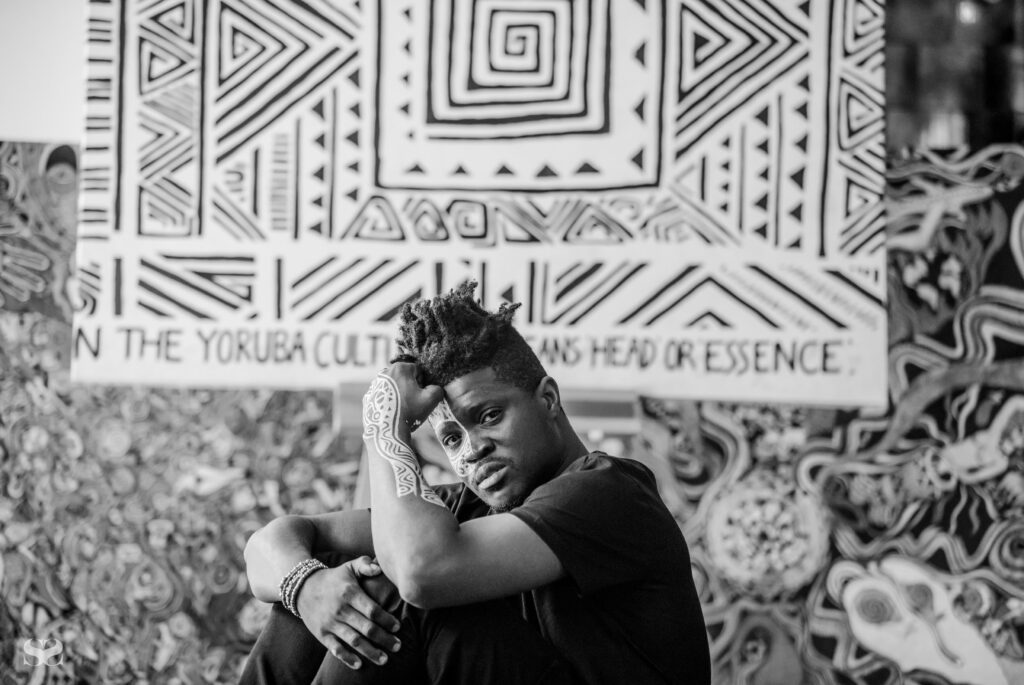
OLAOLUWA, THE CULTURE CUSTODIAN
The Brooklyn artist says he is honoured to be a part of a culture as powerful as the Yoruba culture.
“Being Yoruba affords you so much tapestry, so much background and knowledge, because we come from a people who have studied the stars, people who operate under Yoruba religious philosophical way of thinking….Being able to tap into that culture and that vibe or frequency gives one so much pride. And being able to showcase the culture on platforms and different art projects. When I work with brands, I always make sure to talk about the culture. We’ve studied European art and language all our lives, we speak the English Language. So, it’s not wrong for them to try to understand us too.”
Laolu believes that with art, we can start to reshape people’s thinking of what Africa truly is and people will begin to respect and understand the geniuses of people who have come before us and the complexities of what makes us humans. Because at the end of the day, that’s what it’s all about – understanding that at our core, we are all made of the same fabric.
“So, if you understand Van Gogh or Picasso, then you should study the Nike Ogundayos and Laolu Sebanjos to understand their viewpoints as well.” He finished off.
Laolu is one of the most patriotic Nigerians in the world. Yet, he is sometimes accused of exploiting the Yoruba culture. They wonder why he is charging for these ancient spiritual or sacred arts. His response is a sharp and hard-hitting question, like a typical Nigerian who always responds to a question with a question: “Why are you buying Western art and culture?”
He argues that Africans often undervalue their art, seeing it as less worthy than Western art, a mindset rooted in colonial conditioning. This belief makes some uncomfortable when he monetises his work, revealing how we can be gatekeepers of our oppression.
Laolu points out that the most intelligent Yoruba people he knows don’t speak English, yet they’re often dismissed as less capable because of it.
“Our curriculum will tell us that they’re retards because they can’t translate into English…Until we begin to see things differently, things won’t change “ He believes that our minds have been badly colonized and by taking Yoruba art to the world, he aims to pull himself and some Nigerians from such mental slavery.
He does so, even through his music. As we described in our earlier article, Laolu’s music has a distinct afrofuturistic style. He is constantly pushing the boundaries and daring to be different.
Laolu has been an experimental musician since his church choir days. As a teenager in Nigeria, he was a part of the musical group, “Light and Fire’ – They explored rap and hip-hop, deviating from traditional church music. This experience deepened his understanding of music creation.
His eclectic taste includes Fela Kuti, Beyoncé, jazz, and more. Although music took a backseat to his visual art career for a few years, his recently released “The Ori EP”, featuring artists like Yemi Alade and Seun Kuti, showcases his soulful voice and distinctive sound. Now delving into music licensing for films and blending his music with his artwork, Laolu is excited by Afrobeat’s global rise and is set to release Volume 2 of The Ori EP soon.
LAOLU’S LEGACY IS…
Laolu sees success in the legacy he creates through his art, shaping narratives and influencing perceptions, even in small ways. He measures success by the depth of his impact and the duration of his creative contributions.
Excited about breaking into the Asian market, Laolu plans to explore collaborations in China and Japan and host more solo art shows and workshops in Nigeria to give back and share his knowledge.
Laolu’s journey which spans 20+ years, has broadened his understanding of our shared humanity and the importance of communication, teaching us to be proud and vocal about our art.
I don’t know about you, but I can’t wait to sign up for an afromysterics class!
And maybe, just maybe, I’ll also learn to code mysteries and sacred truths in my art and someday, hopefully, send a message that resonates with an alien or two.
Laolu’s legacy is simply this – to wake us all up from our slumber. To charge us to realise that there is more than what meets the eyes or the physical senses. To awaken our Ori, to connect us with the divinity that is all around us. His legacy is convincing us to truly live – To change our skins as many times as possible, change our destinations if need be, live many lives and chart many territories. To boldly and proudly leave our mark in the universe.
He is Laolu Senbanjo, and from paper to space, EVERYTHING IS HIS CANVAS.
