


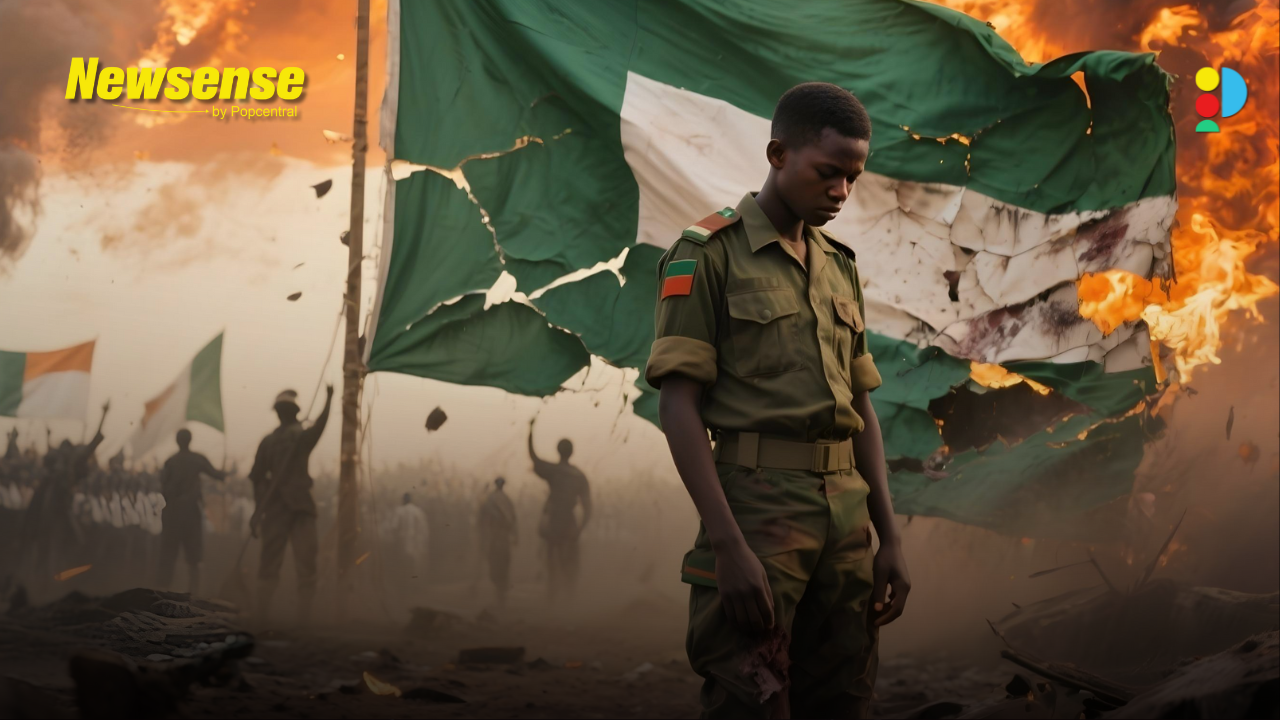
Come close. Imagine this.
It’s October 1st, 1960. Lagos is buzzing. The green-and-white flag is flying for the first time. Streets are full of music and dancing. For the first time in decades, Nigerians feel free. Anything seems possible. The “giant of Africa” has finally woken up.
That joy? That hope? Hold on to it.
Because within seven years, it would all collapse into one of the darkest chapters in our history—the Nigerian Civil War.
A Country Assembled, Not Built
From day one, Nigeria was fragile. It wasn’t a nation carved out by its people; it was assembled by Britain. Over 250 ethnic groups, different languages and histories, all shoved inside one map.
To keep control, the British leaned on three giant regions:
- North – dominated by the Hausa-Fulani, led by Ahmadu Bello, the Sardauna of Sokoto.
- West – Yoruba, led by the brilliant Obafemi Awolowo.
- East – Igbo, led by the charismatic Nnamdi Azikiwe (“Zik”).
They were giants, but rivals. The North had the numbers to dominate politics. The East and West had the education and commerce. It was a three-way tug-of-war for power from day one. Smiles at independence hid the cracks already forming.
The Cracks Widen
The early years were filled with conflict. Federal power in the North was used to weaken rivals. Then came the 1962 census—supposed to be a headcount, but in Nigeria, population equals political power. Accusations of rigging flew. Trust evaporated.
Elections followed. But these weren’t peaceful contests—they were wars. Rigging, arson, killings. Nigeria’s young democracy was burning from the inside.
1966: The Year the Dream Died
On January 15, 1966, young army majors launched Nigeria’s first coup. They killed Prime Minister Tafawa Balewa, the Sardauna, and senior politicians. Most of the coup plotters were Igbo, and most of the victims were from the North and West.
When the dust cleared, Major General Johnson Aguiyi-Ironsi—an Igbo—took control. Intentions aside, to Northerners it looked like conquest. Their leaders dead, their rivals in charge. Suspicion turned into fury.
Ironsi then made a fatal mistake. His Decree 34 scrapped regional autonomy and created one strong central government. To Northerners, this confirmed their worst fears: an Igbo takeover.
By July 1966, Northern officers struck back. Ironsi was captured, tortured, and killed. What followed was a bloody counter-coup. Igbo soldiers were massacred. Across Northern cities, mobs hunted Igbo civilians—men, women, and children. It was one of the darkest waves of ethnic violence in our history.
Hundreds of thousands fled back East, traumatized and furious. Nigeria was broken.
The Final Break
In the East, Lieutenant Colonel Odumegwu Ojukwu faced an impossible question: Can my people ever be safe in Nigeria again?
Meanwhile, General Yakubu Gowon, Nigeria’s new leader, tried to hold the country together. But mistrust was too deep.
Then Gowon made a bold move—he redrew Nigeria’s map, splitting regions into 12 states. For the East, this cut the Igbo heartland off from the oil-rich coast. Ojukwu saw it as strangulation.
On May 30, 1967, Ojukwu declared the Republic of Biafra. For Igbos, it was survival. For Nigeria, it was rebellion.
War was inevitable.
A Nation at War with Itself
The Nigerian Civil War (1967–1970) was brutal. It lasted three years. Over one million people, mostly children, died from starvation and violence. The scars remain.
The Ghosts Still Haunt Us
The Civil War didn’t just end in 1970. Its ghosts are still here:
- The fight over “whose turn” it is for the presidency.
- Endless arguments about oil money and resource control.
- Deep ethnic suspicion that lingers in politics and daily life.
The story of 1960 to 1967 isn’t just history. It’s a warning. Nigeria was born with so much hope, but the wrong mix of rivalry, mistrust, and ambition turned it into tragedy.
As we argue today about zoning, about oil, about who truly belongs, we must remember: we’ve been here before. And the cost of forgetting is too high.
